


Do you want to start climbing or bouldering in 2026? We've compiled the most important tips for beginners to ensure a successful start in the climbing gym.
Trying a new sport can feel overwhelming at first – especially when it involves climbing to great heights. But it doesn't have to be: Here you'll find the most important basics to get started in your climbing or bouldering career.
Indoor climbing: the basics
Safety first
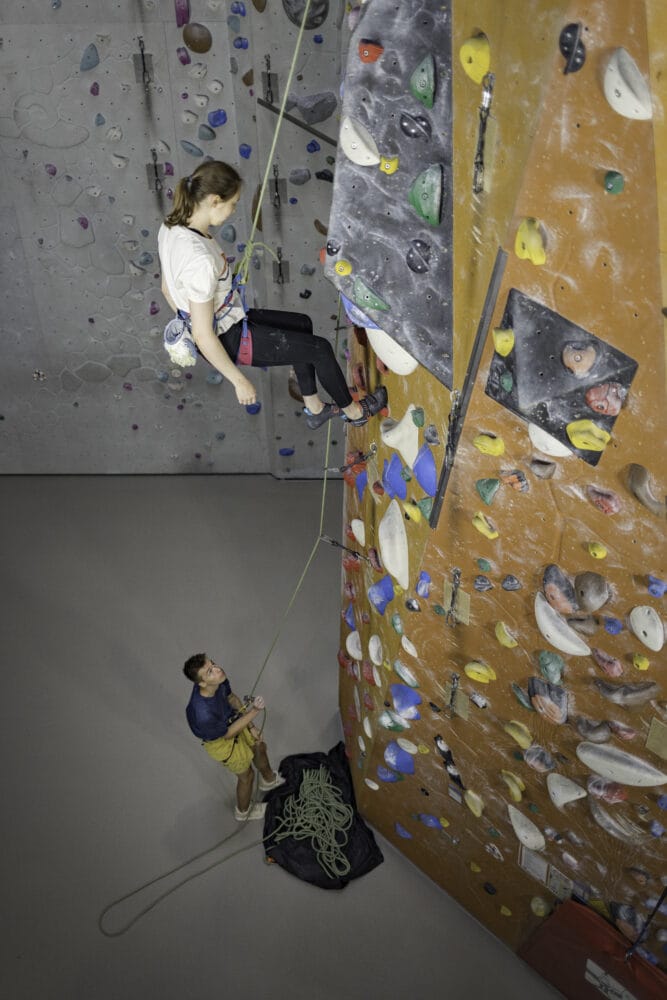
Especially in sport climbing, safety is not something to be taken lightly, as a ground fall poses a serious risk of injury. We therefore strongly advise beginners to participate in a... Belaying and lead climbing course to participate. There you will learn how to tie in correctly and belay properly, depending on whether you are climbing on top rope or lead. This recommendation also applies if you have climbed before, but it has been a while since you last belayed.
Another important factor when climbing and belaying together is the weight of the partners. As a rule of thumb: if there is more than a ten-kilogram weight difference, the lighter person should use an additional sandbag while belaying (available in most climbing gyms) or use specialized belay devices. Backup assistant fall back on.
The most important safety tips for the climbing gym:
- Before climbing: Tie yourself in properly (figure-eight knot!) and familiarize yourself with the backup devices and techniques. Always perform a partner check before climbing (always a self-check when self-belaying).
- When saving: Don't give too much slack in the rope to avoid ground falls, and always keep one hand on the brake rope! Pay attention to your stance and the fall clearance of climbers above you, as well as any weight difference between you and the climber.
- While climbing: When lead climbing, clip all intermediate protection points and avoid clipping from an overextended position to prevent unnecessary falls. Communicate clearly and understandably with your belayer ("rope," "take in," "take down").
- Stay focused: Observe your surroundings, but don't let yourself get distracted while securing the area.
Choosing the right equipment
The right equipment is essential for indoor climbing. As a beginner, you'll need a climbing harness, a belay device, carabiners, climbing shoes, and a rope per team. Before you buy everything yourself: you can rent most of it for a fee at many climbing gyms. Once you decide to purchase your own equipment, there are a few things to keep in mind.
Here's what you should consider when buying equipment:
- Climbing harness: A simple, inexpensive one will suffice to start with. harness From around 50 euros. It's best to try the belt on before buying: it should fit snugly around the hips and not be too loose around the legs.
- Safety device: Meanwhile, so-called semi-automatic Backup devices These are well-established and also recommended by the German Alpine Club (DAV). They lock automatically in the event of a fall or during lowering, ensuring greater safety while climbing.
- Carabiner: To attach a belay device to your climbing harness, you need a securely locking buckle. CarbineCaution: Not every carabiner is compatible with every belay device. If in doubt, ask your trusted retailer.
- Rope: Even if a rope is already available at the climbing gym (or from your climbing partner), it's worth buying your own climbing rope at some point. Usually, one is sufficient. Single rope with a length of 50 meters and a diameter of approximately 10 millimeters. Important: The specifications may vary depending on the climbing gym.
- Climbing shoes: To the right one climbing shoe To find the right shoes for your feet, beginners should consider getting a shoe fitting. Many outdoor shops offer this service with trained sales staff. Generally speaking, your first shoes should fit snugly but not be uncomfortable (you don't need models with a strong downturn for beginners). If you still experience significant pain in your toes or heels after breaking them in, the shoes might not be right for you. It's also a good idea to get advice from experienced climbers about shoe size.
- Optional equipment: A Safety glasses You always maintain an overview while securing – without a stiff neck from constantly looking up. Backup Assistant It can also be clipped into the rope as an intermediate anchor. This reduces rope friction and compensates for any weight differences between the climber and the belayer.
Important: Climbing equipment wears out over time and must be replaced regularlyTo ensure the necessary safety, this applies especially to textile materials such as climbing harnesses and ropes. Check with the seller or manufacturer to find out how often you should change your equipment.
Climbing efficiently – saving energy
That feeling after your first few climbing sessions that your forearms are about to fall off? That's perfectly normal. However, especially as a beginner, you should learn energy-saving basic techniques as early as possible. This way, you'll work on proper climbing technique from the start and won't be completely exhausted after just two routes.
The most important tech tips for beginners:
- Climbing with a long arm: With your arm extended and as relaxed as possible, your legs can provide maximum support. This conserves energy and prevents you from getting "pumped" too quickly. An efficient climbing style relies on extended arms and bent knees.
- Find and use resting positions: To rest on the route, let your free arm hang down and shake it out. With large holds, you can also switch hands on the hold so that both arms are relieved alternately.
- Step correctly: Always place your weight precisely on footholds with your toes, not your midfoot. Especially inexperienced climbers often try to rely too heavily on brute force at the beginning and overlook the potential savings from proper footwork. Your legs bear most of the load when climbing – and if you choose footholds under your center of gravity, your arms will only be used for balance. You'll learn to choose the right footholds primarily through increasing climbing experience.
- Grip correctly: You can also conserve finger strength when gripping by applying pressure to the handles as they are designed to be applied (straight handles from below, side handles from the side). Hold the handles as loosely as possible and as firmly as necessary. This way, you avoid straining your arm and finger muscles by unnecessarily gripping tightly. "Standing up" on small handles is also not recommended for beginners.

Indoor bouldering: the basics
Fall correctly
Falls onto the mat are part of bouldering – and learning how to fall properly is essential. Climbing gym accident statistics This shows that significantly more accidents occur in bouldering gyms than in climbing gyms. Many of these injuries could be avoided through fall training.
How to fall correctly while bouldering:
- Unroll: If possible, let yourself fall onto your feet, bend your legs and roll backward. Keep your core engaged, your back slightly rounded and your chin tucked towards your chest – like when you're doing a roll.
- Do not catch it with your arms: Especially in the case of sideways falls, you should not try to break your fall with your forearms – as the impact poses a high risk of injury to your wrists, elbows, and shoulders. Even when falling sideways, try to roll your body over the back of your (upper) arm.
- Better to let go: The urge to hold on as long as possible while falling is understandable. However, this can actually worsen a fall because it causes the body to rotate more and fall more uncontrollably. Therefore, if you realize you can no longer hold on, let go sooner rather than later.
- Practice creates masters: Practice falling actively from the very beginning and develop a routine by jumping from a low height. This way you'll be prepared for an emergency.
Important: Also be aware of the potential fall zone of others and speak to anyone who is in your fall zone. In climbing gyms, this often applies to children who are unaware of the risks. While you as a climber are not at fault if you fall on someone, the situation is still unpleasant and avoidable.

Observe safety and etiquette
Those bouldering indoors for the first time might stumble into a pitfall they're not even aware of. Because even in bouldering gyms, a certain culture of unwritten rules has developed. etiquette established so that everyone can have a good time together and travel safely.
You should know these rules of conduct:
- Keep the fall zone clear: Keep the landing zone clear of water bottles, headphones, shoes, or other objects. If, for example, bottles are prohibited on the mat in a hall, abide by this rule.
- Keep it clean: Cleaning the holds and footholds before and after bouldering ensures better grip for everyone in the gym – and that the problems remain climbable for longer. Also, avoid using excessive amounts of chalk/magnesium. Note: Some gyms now only allow chalk/magnesium. Liquid chalk allowed.
- Don't push in: Someone just cleaned a boulder? That person probably wants to try it soon. Don't push in; wait until your fellow climber has had their turn.
- Don't climb too close to each other: This falls under the safety aspect. Only start climbing a boulder problem when no one can climb in your way. Whoever was on the wall first has priority.
- Refrain from giving unsolicited advice: Exchanging ideas about a bouldering problem with each other is great, but refrain from offering unsolicited advice. For many people, part of the appeal of bouldering is also finding the solution themselves.

Understanding levels of difficulty
6a+, V3, 5.10, 7-? When bouldering and climbing, beginners quickly encounter seemingly cryptic rating systems, depending on the climbing gym. In our Articles about the different climbing scales You'll learn about the different systems. Different scales are used depending on the sport, country, or even region. Many climbing gyms have now adopted a numerical system. This usually starts at 1 (very easy) and goes up to 7, 8, 9, or even 10 (very difficult).
As a general rule, difficulty ratings offer beginners a good guide when choosing suitable bouldering problems. However, they can also create pressure if the grade takes precedence over the enjoyment of the movement.
Tips for dealing with difficulty levels:
- Note the differences between halls: Climbing gyms are individual and usually have different route-setting teams. Therefore, the difficulty levels cannot vary from gym to gym. Avoid unnecessary frustration by checking the (number of) levels offered by a gym before your session.
- No "I must" thinking: You usually manage all the boulders at difficulty level XY? That's great – but it's no guarantee that you'll always succeed. If you're bouldering in a new gym for the first time or venturing outside your usual style, you might find a boulder unusually difficult for its grade. Try to see this as an opportunity to learn something new – and let go of the idea that you "have to" solve this problem.
- Get out of your comfort zone: A boulder problem on an overhang demands different skills than one on a positively inclined wall (and vice versa). Beginners especially benefit from trying out many different bouldering styles as early as possible. Instead of avoiding certain boulders, you can expand your movement and technique repertoire from the start and learn a lot along the way.

Stay injury-free – while climbing and bouldering
In addition to specific tips for indoor climbing and bouldering, we would like to give beginners some general recommendations for the sport in order to stay injury-free for as long as possible.
Here's how to avoid unnecessary injuries:
- Correct warm-up: Proper warm-up improves endurance and helps prevent injuries. Incorporating a few mobility, stretching, and strength exercises into your routine will help you stay healthy. warm-up program By integrating these techniques, you are physically preparing yourself for the strain of climbing. This applies especially to the body parts that are most stressed during climbing: fingers, arms, and shoulders.
- Stay away from hangboards and campusboards: Experts agree that special training tools such as Hangboards or that the campus board does significantly more harm than good to beginner fingers. This is because our fingers simply take longer to adapt to the demands of climbing than, for example, our leg or core muscles. As a rule of thumb: Finger training Only from climbing grade 7 onwards or after at least two years of climbing. If you still want to train from the beginning, you can with balance training, a targeted technology session or Flexibility exercises Achieve more, faster.
- Listen to your body: Stop climbing if you're exhausted or experiencing pain. Climbing and bouldering put a lot of strain on the body. Give your muscles, tendons, and joints time to adapt. Also, make sure to take enough rest days between climbs – then progress will (almost) come naturally.
That might interest you
- After a climbing break: How to get back into it
- These are the best (and worst) training exercises for climbers
+ + +
Credits cover photo: DAV/Jens Klatt