


The 14 highest peaks in the world are over 8.000 meters high and have long fascinated and attracted the mountaineering community. We've compiled the most important facts and figures about all eight-thousanders to help you brush up on your alpine knowledge.
As eight-thousander Mountains are generally considered to have a main peak over 8.000 meters high. There are 14 of these worldwide – and only in Himalayas- and KarakorumMountains. The roofs of the world are thus distributed among the countries of India, Nepal, Pakistan, China, and the autonomous region of Tibet.
The eight-thousanders are also the only mountains where the so-called "death zone" exists, which is usually defined as starting at 8.000 (less frequently at 7.000) meters. There, the oxygen level in the atmosphere is only 30 percent of that at sea level, which is why a stay longer than 48 hours is considered incompatible with human life.
High-altitude mountaineering: a story of border crossers
Despite all the dangers, the fascination of the eight-thousanders dates back to the first attempts almost 100 years ago. However, the first successful summit was not achieved until 1950, when the Frenchmen Maurice Herzog and Louis Lachenal reached the summit of the Annapurna in Nepal, at 8.091 meters, the tenth highest mountain in the world. In the 50s, a wave of first ascents of the world's highest peaks followed, culminating in 1964 with the last and smallest of the eight-thousanders, Shishapangma (8.027 m).
Since then, there have been many records around the 14 roofs of the world: first winter ascents, solo ascents, and ascents without supplemental oxygen. In 1986, Reinhold Messner was the first person to climb all 14 eight-thousanders without supplemental oxygen – a milestone in mountaineering that only between 40 and 50 people have achieved to date. In 2011, the Austrian Gerlinde Kaltenbrunner as the first woman to achieve this.
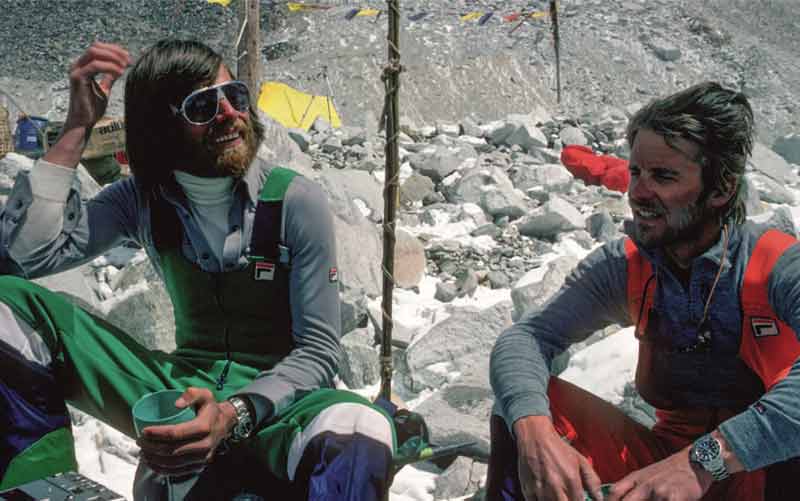
It was also Messner who, together with Peter Habeler the Mount Everest first time without supplemental oxygen, and who in the same year climbed the first solo without support on Nanga Parbat managed.
All 14 eight-thousanders – from small to large
Below we list all 14 eight-thousanders in ascending order – with information on location, first ascents, and trivia.
14. Shishapangma (8.027 m)

It is the "smallest" eight-thousander: Shishapangma is characterized by a short approach to base camp, but at the same time is not necessarily one of the easiest of the 14 to climb. Since the mountain lies entirely in the now autonomous region of Tibet, it was the last eight-thousander to be climbed in 1964, due to China's political control.
Because the central summit (8.012 m) is easier to reach than the actual highest point, there has been a recurring dispute over "true" ascents of Shishapangma. Especially when climbing all 14 eight-thousanders, summits of Shishapangma are controversial if alpinists have not reached the "true summit."
- Also known as: Xixabangma
- Mountains: Himalayas
- Country: China, Tibet
- First ascent on: 02.05.1964
- First climber:
- First ascent in winter: January 14.01.2005, XNUMX
- Ascents to date1: around 400 (main summit), around 900 (central summit at 8.013 m)
- Known for: "smallest" eight-thousander, last climbed eight-thousander
13. Gasherbrum II (8.034 m)

As a mountain in the border region between Pakistan and China, Gasherbrum II lies near Broad Peak and Gasherbrum I, with which it forms the Gasherbrum Group in the Karakoram Mountains. It is considered a good preparation for Mount Everest and, like Shishapangma, is relatively less steep. Gasherbrum II is also popular with ski mountaineers and is one of the few eight-thousanders where a ski descent is within reach. The name "Gasherbrum" means something like "beautiful mountain," but is often mistranslated as "shining wall."
- Mountains: Karakoram
- Country: China, Pakistan
- First ascent on: 07.07.1956
- First ascents: Fritz Moravec, Josef Larch, Hans Willenpart (AUT)
- First ascent in winter: January 02.02.2011, XNUMX
- Ascents to date: around 1.100
- Known for: first of the four eight-thousanders in the Karakoram and the five Pakistani eight-thousanders to be climbed in winter (2011)
12. Broad Peak (8.051 m)

Broad Peak owes its name to the 1,5-kilometer-long chain of peaks. It belongs to the same mountain range as the Gasherbrum peaks and is often used as a training summit for the difficult K2. Despite its less intimidating appearance, Broad Peak, with its frequent storms and avalanches, poses no less risks than many other eight-thousanders. It was the third-to-last of the 2013 peaks to be climbed in winter for the first time in 14.
- Also known as: Falchan Kangri, K3 (until 1856)
- Mountains: Karakoram
- Country: China, Pakistan
- First ascent on: 09.06.1957
- First ascents: Hermann Buhl, Kurt Diemberger, Marcus Schmuck, Fritz Wintersteller (AUT)
- First ascent in winter: January 05.03.2013, XNUMX
- Ascents to date: around 600
- Known for: first eight-thousander to be climbed in alpine style (first ascent in 1957)
11. Gasherbrum I (8.080 m)

Gasherbrum I is so remote that it is often called the "Hidden Peak." Due to its location, among other things, but also in view of its more prominent neighbors such as Broad Peak, Gasherbrum II, and K2, it remains one of the less frequently visited eight-thousanders. Its unpredictable weather and sometimes extreme cold also make Gasherbrum I the least popular of the 14 highest peaks.
- Also known as: Hidden Peak, K5 (until 1892)
- Mountains: Karakoram
- Country: China, Pakistan
- First ascent on: 05.07.1958
- First ascents: Peter K. Schoening, Andrew J. Kauffman (USA)
- First ascent in winter: January 09.03.2012, XNUMX
- Ascents to date: around 400
- Known for: first attempt to climb in 1934 (unsuccessful)
10. Annapurna I (8.091 m)

Although Annapurna was the first of all eight-thousanders to be climbed, it is still considered one of the most dangerous. With a high historical fatality rate of 32 percent (deaths as a percentage of summit attempts), the highest peak in the Annapurna massif is reserved for only extremely experienced alpinists. In addition to the high avalanche danger, the routes on Annapurna I are very steep and require tremendous endurance, strength, and technical skill.
- Also known as: Morshiadi (obsolete)
- Mountains: Himalayas
- Country: Nepal
- First ascent on: 03.06.1950
- First ascents: Louis Lachenal, Maurice Herzog (FRA)
- First ascent in winter: January 03.02.1987, XNUMX
- Ascents to date: around 520
- Known for: first climbed eight-thousander
9. Nanga Parbat (8.125 m)

Nanga Parbat's nickname is "Killer Mountain" – and that pretty much says it all. Before 1990, the mountain had a fatality rate of 77 percent and is still considered the third most dangerous eight-thousander after Annapurna I and K2. Its southern Rupal Face, at 4.600 meters, is the highest steep face in the world. In 1970, the Messner brothers climbed it in its entirety for the first time. Günther Messner died on Nanga Parbat that same year under circumstances that remain controversial; his brother survived.
- Also known as: Diamir
- Mountains: Himalayas
- Country: Pakistan
- First ascent on: 03.07.1953
- First ascent: Hermann Buhl (AUT)
- First ascent in winter: January 26.02.2016, XNUMX
- Ascents to date: around 400
- Known for: Eight-thousander with the highest death rate, westernmost eight-thousander, Terrorist attack in 2013
8. Manaslu (8.163 m)

Although Manaslu is among the ten highest mountains in the world, it is one of the more "realistic" eight-thousanders within this category. Four camps are located on the moderately ascending normal route before a final steep snow ridge leads to the summit. Manaslu was the only eight-thousander to be first climbed by a Japanese and still enjoys exceptional popularity among Japanese expedition teams.
- Mountains: Himalayas
- Country: Nepal
- First ascent on: 09.05.1956
- First ascents: Gyalzen Norbu (NPL), Toshio Imanishi (JPN)
- First ascent in winter: January 12.01.1984, XNUMX
- Ascents to date: around 3.300
- Known for: fatal expedition of 1991 by well-known South Tyrolean mountaineers (Hans Kammerlander, Carlo Großrubatscher, Friedl Mutschlechner)
7. Dhaulagiri I (8.167 m)

Dhaulagiri is similarly remote to Gasherbrum I and is also one of the less frequently visited eight-thousanders. As Nepal's highest mountain, it was the second-to-last of the 1960 peaks climbed in 14. A plane used during the expedition crashed into the Dhaulagiri Icefall at about 5.700 meters and remains there to this day.
Dhaulagiri is particularly known for its abrupt rise on the Gandaki Riverbed. Its name comes from Sanskrit and means "white mountain." Until the early 19th century, it was considered the highest mountain in the world.
- Mountains: Himalayas
- Country: Nepal
- First ascent on: 13.05.1960
- First ascents: Kurt Diemberger (AUT), Nawang Dorje (NPL), Ernst Forrer, Albin Schelbert, Peter Diener (SUI), Nyima Dorje (NPL)
- First ascent in winter: January 21.01.1985, XNUMX
- Ascents to date: around 700
- Known for: second-to-last climbed eight-thousander and highest mountain whose summit does not lie on a national border
6. Cho Oyu (8.188 m)
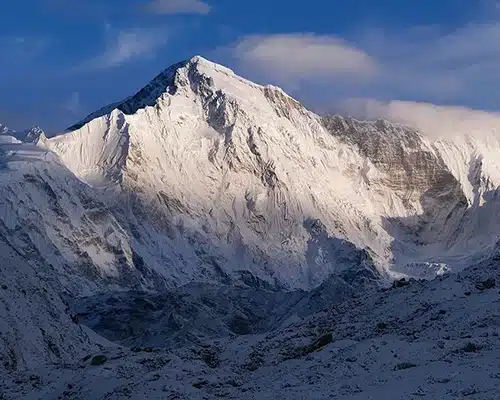
If there is such a thing as a "beginner's eight-thousander," it is Cho Oyu. It is considered good preparation for Mount Everest, as its high camp at 7.400 meters offers excellent training for oxygen equipment and acclimatization. The comparatively gentle gradient and less technical normal route make Cho Oyu the first eight-thousander for many alpinists. It was the first eight-thousander to be climbed by a woman—Claude Kogan of France—in 1959.
- Mountains: Himalayas
- Country: China, Nepal
- First ascent on: 19.10.1954
- First ascents: Josef Jöchler, Herbert Tichy (AUT), Pasang Dawa Lama (NPL)
- First ascent in winter: January 12.02.1985, XNUMX
- Ascents to date: around 4.000
- Known for: most frequently climbed eight-thousander, eight-thousander with the fewest fatalities; first eight-thousander climbed by a woman
5. Makalu (8.485 m)

Makalu stands out – not only because of its single summit, but also because of its extremely steep walls and particularly exposed passages. A nearly perfect four-sided pyramid, the fifth-highest eight-thousander lies about 20 kilometers east of Mount Everest, but is considered considerably more difficult to climb. Winter expeditions to Makalu, in particular, are notorious for their low success rate. The Makalu-Barun Valley in the eastern Himalayas is a protected national park and known for its unique flora and fauna.
- Also known as: Makaru Shan
- Mountains: Himalayas
- Country: China, Nepal
- First ascent on: 15.05.1955
- First ascents: Lionel Terray, Jean Couzy (FRA)
- First ascent in winter: January 09.02.2009, XNUMX
- Ascents to date: around 800
- Known for: first successful ascent of an eight-thousander by all expedition members
4. Lhotse (8.516 m)

Lhotse is one of Mount Everest's immediate neighbors and is often climbed in combination with the Roof of the World. Both mountains share a standard route to Camp Four; after summiting Everest, it's possible to reach the summit of Lhotse via the South Col.
Those who conquer the Lhotse face, with its crevasses and frequent icefalls and avalanches, will be rewarded with a spectacular panorama of Everest, Nuptse, Makalu and the entire Khumbu region on the fourth highest mountain in the world.
- Mountains: Himalayas
- Country: China, Nepal
- First ascent on: 18.05.1956
- First ascents: Fritz Luchsinger, Ernst Reiss (SUI)
- First ascent in winter: January 31.12.1988, XNUMX
- Ascents to date: around 1.200
- Known for: Neighbouring mountain of Mount Everest, over 3.000 metre high rock walls on the south side
3. Kangchenjunga (8.586 m)

The name of India's highest mountain translates as "the five treasures of snow" and was inspired by the five prominent peaks of Kangchenjunga. As the easternmost eight-thousander, it was considered the world's highest mountain until 1852. On the Indian side, Kangchenjunga National Park is recognized as a UNESCO World Heritage Site.
Despite its place among the world's top three highest peaks, Kangchenjunga is less visited than Everest, Lhotse, or K3. Out of respect for the mountain's significance in Sikkimese culture, it has become established that summit aspirants pause a few meters before reaching the actual summit. This tradition dates back to the first ascent in 2.
- Also known as: Kanchenjunga, Kantsch
- Mountains: Himalayas
- Country: India, Nepal
- First ascent on: 25.05.1955
- First ascents: George Band, Joe Brown (GBR)
- First ascent in winter: January 11.01.1986, XNUMX
- Ascents to date: around 600
- Known for: highest mountain in India, easternmost eight-thousander
2. K2 (8.611 m)

"A wild mountain that tries to kill you" – that's how Reinhold Messner once described K2, which to this day is as feared as Nanga Parbat and Annapurna. Even the normal route presents an extremely demanding ascent via the Abruzzi Ridge, and there's also considerable danger of rockfall, avalanches, and bad weather.
Since Messner's quote, K2 has never been able to shake off its nickname "Wild Mountain." For good reason: Historically, one in four summit attempts has ended in death. It's no wonder, then, that K2 was the last of the 14 eight-thousanders to be climbed in winter: Only in January 2021, a ten-person Nepalese team Nimal Purja the historic undertaking – and was successful.
- Also known as: Qogir, «Wild Mountain»
- Mountains: Karakoram
- Country: China, Pakistan
- First ascent on: 31.07.1954
- First climber: Achille Compagnoni, Lino Lacedelli (ITA)
- First ascent in winter: January 16.01.2021, XNUMX
- Ascents to date: around 800
- Known for: most difficult eight-thousander; last eight-thousander to be climbed in winter
1. Mount Everest (8.848 m)

It hardly needs any introduction: The Mount Everest As the highest mountain in the world, it is also the most frequently climbed of all 14 eight-thousanders. Around 14.000 people have reached the summit of Everest to date – the last 2025 in the spring season of 722. Despite fluctuations, the number of Everest visitors has steadily increased over the past 20 years – the record year was 2019 with 877 successful ascents. Most ascents take place on the Nepalese side; significantly fewer expeditions depart from Tibet.
Despite less dangerous conditions than, for example, Nanga Parbat or K2, Everest offers harsh conditions with temperatures as low as -60°C and winds over 160 km/h, which, combined with the extreme altitude, result in several deaths each year. Kami Rita Sherpa holds the record for the most summits of Mount Everest, which grows in height by about 4 millimeters each year due to tectonic activity. In May 2025, he stood on the roof of the world for the 31st time.
- Also known as: Sagarmatha, Qomolangma
- Mountains: Himalayas
- Country: China, Nepal
- First ascent on: 29.05.1953
- First ascents: Edmund Hillary (NZL), Tenzing Norgay (NPL)
- First ascent in winter: January 17.02.1980, XNUMX
- Ascents to date: approx. 14.000
- Known for: highest eight-thousander
That might interest you
- Summary: This was the 2025 spring season on Mount Everest
- Anja Blacha climbs her tenth eight-thousander
+ + +
Credits Cover image: Adobe Stock
- based on confirmed summits from the Himalayan Data Base, further research, and partly AI-supported projections based on known expedition activities, seasonal strengths, and trends. ↩︎